Enter the fascinating world of the violin...
Four-stringed musical instrument tuned in fifths, played with a bow, and held between the shoulder and the chin.

It is hard to believe that this small instrument, made of simple pieces of wood cut out and glued together, consisting of only four cords, and whose sound range and volume are relatively low, has acquired such prominence in the world of music. The prodigy is one of the incomprehensible phenomena of the history of mankind!
The Violin
The violin, the most commonly used member of the modern string family, is the highest-sounding instrument of that group.
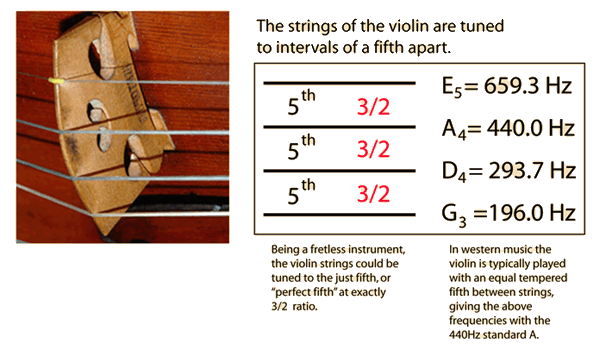
The strings are tuned a fifth apart at G3(196 Hz), D4, A4, E5(659.3 Hz) using the A4 = 440Hz standard. Strings characteristically produce a fundamental resonance plus all the string harmonics. The sound of the instrument is enhanced by body resonances including the air resonance of the f-holes.
Some Violin Details
The violin, the most commonly used member of the modern string family, is the highest-sounding instrument of that group. Its four strings are stretched over a high arched bridge that permits the playing of one or two strings at a time, as well as the nearly simultaneous sounding of three or four as chords. The overall length of the violin averages about 60 cm (23.5 in), whereas the sounding length of the strings, from bridge to the nut at the end of the fingerboard, is about 32 cm (12.75 in). The instrument is held on the left side of the body, while the right hand holds the bow. The wider end of the instrument is placed between the player's left shoulder and chin, while the left hand encircles its neck, the fingers stopping the strings to produce the various pitches. Sound is produced by drawing the bow across the strings to make them vibrate, or by plucking the strings (PIZZICATO).
The range of the violin extends from G, the lowest open string, upward nearly four octaves. The strings are tuned a fifth apart at G3(196 Hz), D4, A4, E5(659.3 Hz).
Many consider that violin making reached its pinnacle in the work of Antonio Stradivari and Guiseppe Guarneri in the 18th century. Although the basic construction of the violin has been long established, the subtle variations which make an outstanding violin are the stuff of legend.
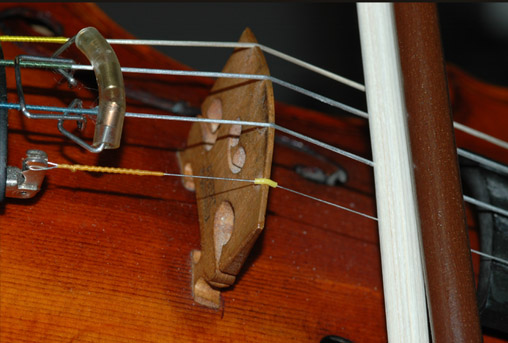
The sound quality can be changed considerably by the place
where the string is bowed. If bowed close to the bridge (sul ponticello)
then the sound is brighter with more harmonic content. If bowed further from the bridge (sul tasto) then the sound is darker, more mellow with less harmonic content.
Violin Construction
|
The modern violin consists of about seventy parts. Parts include the
belly, the back, the ribs, inside blocks, inside lining, bass bar,
purfling, finger board, neck, scroll, nut, lower nut, tailpiece, loop,
end button, pegs, strings, bridge,
and the sound post. The body of the violin is a hollow box which
measures about 35.5 cm in length. The back, the neck, the ribs and the
bridge are usually made of maple. The belly, linings, and the soundpost
are usually made of spruce. Scrupulous care is taken in selecting and
shaping the belly and back. They must be adjusted to certain frequencies
before assembly in order for the main wood resonance of the instrument to be of the apppropriate strength and pitch.  Violin Bridge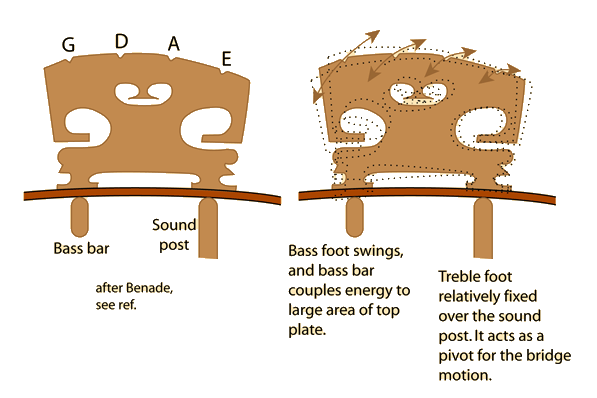 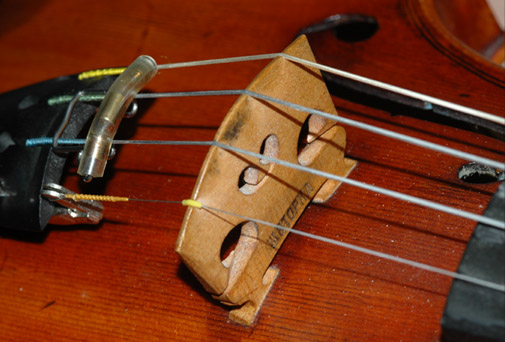 The action of the violin bridge is essential to the tone of the instrument. It's shape and function have been developed over centuries. Underneath the treble side of the bridge (where the E string rests) is the sound post which extends from the front to the back plate of the instrument. Since this side of the bridge rests on this post, it is essentially fixed and acts as a pivot for the rocking motion of the remainder of the bridge. It does however, couple the sound energy from the top plate to the back plate of the instrument. Underneath the bass side of the bridge (where the G string
rests), a long, thin wooden strip called the bass bar is attached,
almost parallel to the strings. This bass foot of the bridge is more
free to move, and its motion is the point of transfer of energy from the
strings to the top plate of the instrument. The extended bass bar helps
it to transfer the energy to a larger area of the top plate. As can be
seen from the diagram, the amplitude of motion is larger for the bass
strings. This is desirable for balance of loudness, since the
sensitivity of the ear drops off a bit toward the lower frequencies of
the instrument. Reference & Adaptation from: www.hyperphysics.phy-astr.gsu.edu/hbase/Music/violin.html |
